Shurat HaDin works with a network of volunteer lawyers across the globe to combat antisemitism, extremist hate and delegitimization. We challenge BDS campaigns in court, warn institutions of their liability, and hold social media giants to account for incitement.
Israel and Jewish communities around the world face a dangerous international campaign to delegitimize the Jewish State through the Boycott, Divestment and Sanctions (BDS) movement.
Unable to defeat the IDF militarily or to weaken Israel’s population through persistent terrorism, extremist groups have embarked on a global campaign to demonize, delegitimize and isolate Israel. They challenge its right to exist and cast it as a pariah state at the United Nations and in academic institutions.
The BDS campaign, and its use of “lawfare” to attack Israel and Israelis with baseless legal actions, is the main component of the “Durban Strategy” adopted by Israel’s opponents at the UN’s human rights conference in 2001. Behind BDS activists’ claim of assisting the Palestinian cause lie racial discrimination and antisemitism. As the Anti-Defamation League has stated: “The BDS movement at its very core is anti-Semitic.”
How Shurat HaDin fights BDS
Shurat HaDin has taken a lead in combating BDS: supporting legislation that prohibits and penalizes racist and antisemitic boycotts, exposing organizations that fund BDS activity, filing legal challenges to unions and academic societies that seek to implement BDS policies, and using international and domestic law to foil attempts to weaken Israel’s security. Its recent efforts include:
Blocking a hostile flotilla bound for Gaza, by warning maritime insurers and a satellite communications company that serving it could make them liable for aiding terrorists.
Warning academic institutions of their civil and criminal liability for tolerating an environment that fails to protect Jewish and Israeli students from antisemitic harassment.
Seeking to remove the tax-exempt status of organizations that promote boycotts of Israeli companies and academics.
Filing amicus curiae petitions in Israel’s High Court of Justice on behalf of the IDF and intelligence branches.
On campus
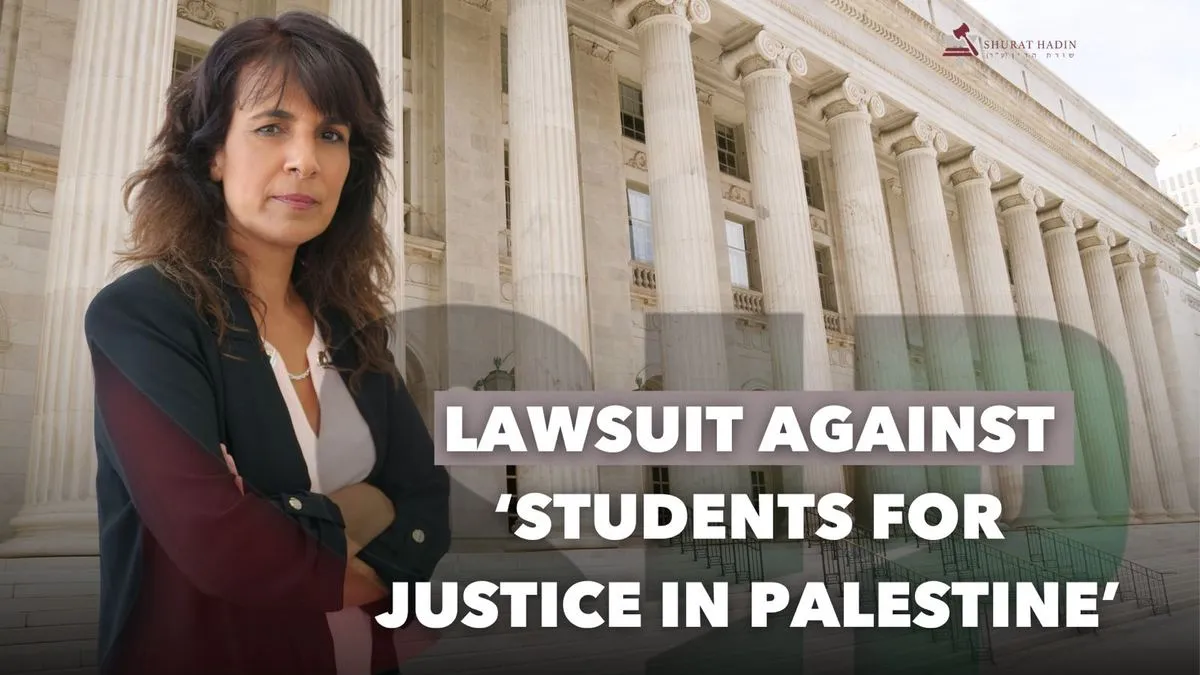
Announcement · Shurat HaDin’s announcement of the lawsuit against Students for Justice in Palestine.
In a lawsuit Shurat HaDin announced in May 2024, eight families of terror victims, 60 plaintiffs in all and among them victims of October 7th, filed a lawsuit in the Middle District of Florida under the Anti-Terrorism Act against Students for Justice in Palestine (SJP), its affiliated network of student organizations and their leaders. The complaint argues that SJP, a network of more than 200 university chapters, was established as a successor to organizations designated as terrorist, and that it provides Hamas with material support.
“If we don’t act urgently against these organizations, America will face the very real threat of its own October 7th.”
Nitsana Darshan-Leitner, founder and president, Shurat HaDin
Shurat HaDin analyzes each BDS campaign under the law of the place where it happens.
01
We hear from you
Concerned individuals often tell Shurat HaDin about a BDS campaign taking place in their home city.
02
We analyze the law
Shurat HaDin analyzes the legality of the specific campaign according to local laws.
03
We send a warning
If the activity is illegal, a strongly worded letter goes to the organizers and to the institutions being targeted. It warns that capitulating to BDS is unlawful and may expose them to civil, administrative and criminal action.
04
We take legal action
If the organizers do not heed the warning and cease their BDS activities, Shurat HaDin follows through in court.
Airbnb reverses its boycott of Jewish homes in Judea and Samaria
In November 2018 Airbnb bowed to BDS pressure and banned listings of Jewish homes in Judea and Samaria. Shurat HaDin immediately sued under the Fair Housing Act on behalf of Israeli and Jewish-American homeowners and renters. Under a settlement in 2019, Airbnb rescinded the policy and agreed to treat all properties in the region neutrally.
“Boycotting Israel and discriminating against Jews are unlawful acts which will ultimately result in dire legal consequences, public condemnations, and embarrassment.”
When Ben & Jerry’s announced in July 2021 that it would stop selling in what it called “Occupied Palestinian Territory”, Shurat HaDin led the legal battle, drawing on Israel’s 2011 law allowing civil suits against those who call for boycotts. As a countermove, it moved to register the name “Judea and Samaria’s Ben & Jerry’s” and notified Unilever of its next steps.
Internal Revenue Service
IRS complaint against the Presbyterian Church USA
A complaint that seeks to revoke the church’s tax-free status after its divestment from companies doing business in Israel.
Jerusalem Magistrates’ Court
Judgment against New Zealand BDS activists
Two activists who urged the singer Lorde to cancel her Tel Aviv concert were ordered to pay damages to three Israeli teenagers.
Crowd-funding
Donorbox cancels the BDS National Committee’s campaign
The platform removed the campaign after cease-and-desist letters documented the BNC’s ties to designated terror groups.
Cologne, Germany
A German bank closes a BDS group’s account
After a warning of liability under the US Anti-Terrorism Act, the bank closed the account of Jewish Voice for Just Peace in the Middle East.
Israel’s High Court of Justice
Human Rights Watch official Omar Shakir deported
The end of a three-year battle: Israel deported Shakir on November 25, 2019, after a landmark anti-BDS ruling.
US Courts of Appeals
Amicus briefs defending Arkansas and Texas anti-BDS laws
Friend-of-the-court briefs in the Eighth and Fifth Circuits expose the violent underbelly of the BDS movement.
Radical Islamic jihadists and other terror groups have adopted TikTok, Twitter and Instagram to recruit followers, incite violence and carry out their attacks. Hamas, Hezbollah, Fatah and Islamic Jihad all use social media to spread their messages, recruit and raise funds, while the providers have largely turned a blind eye.
Shurat HaDin has led a public campaign to challenge these companies for their complicity in the terror their services facilitate, to compel them to self-regulate, and to press elected officials to act against antisemitism and incitement on the platforms. It has taken the lead in arguing that Section 230 of the Communications Decency Act of 1996 cannot give these companies blanket immunity. They are publishers, curators and editors of their content, not “neutral bulletin boards”.
2015 · Cohen v. Facebook
On behalf of some 20,000 Israelis
Filed on October 26, 2015, the suit seeks an injunction requiring Facebook to monitor incitement and respond immediately to complaints.
2016 · Force v. Facebook
A suit for victims of terror
Filed for terror victims and their families against Facebook for providing its services to Hamas.
US Supreme Court
Petition for review
After the Second Circuit affirmed dismissal 2–1, with Chief Judge Robert Katzmann dissenting, Shurat HaDin assisted in petitioning the Supreme Court.





The social media battlefield
Holding the platforms to account
Radical Islamic jihadists and other terror groups have adopted TikTok, Twitter and Instagram to recruit followers, incite violence and carry out their attacks. Hamas, Hezbollah, Fatah and Islamic Jihad all use social media to spread their messages, recruit and raise funds, while the providers have largely turned a blind eye.
Shurat HaDin has led a public campaign to challenge these companies for their complicity in the terror their services facilitate, to compel them to self-regulate, and to press elected officials to act against antisemitism and incitement on the platforms. It has taken the lead in arguing that Section 230 of the Communications Decency Act of 1996 cannot give these companies blanket immunity. They are publishers, curators and editors of their content, not “neutral bulletin boards”.
2015 · Cohen v. Facebook
On behalf of some 20,000 Israelis
Filed on October 26, 2015, the suit seeks an injunction requiring Facebook to monitor incitement and respond immediately to complaints.
2016 · Force v. Facebook
A suit for victims of terror
Filed for terror victims and their families against Facebook for providing its services to Hamas.
US Supreme Court
Petition for review
After the Second Circuit affirmed dismissal 2–1, with Chief Judge Robert Katzmann dissenting, Shurat HaDin assisted in petitioning the Supreme Court.